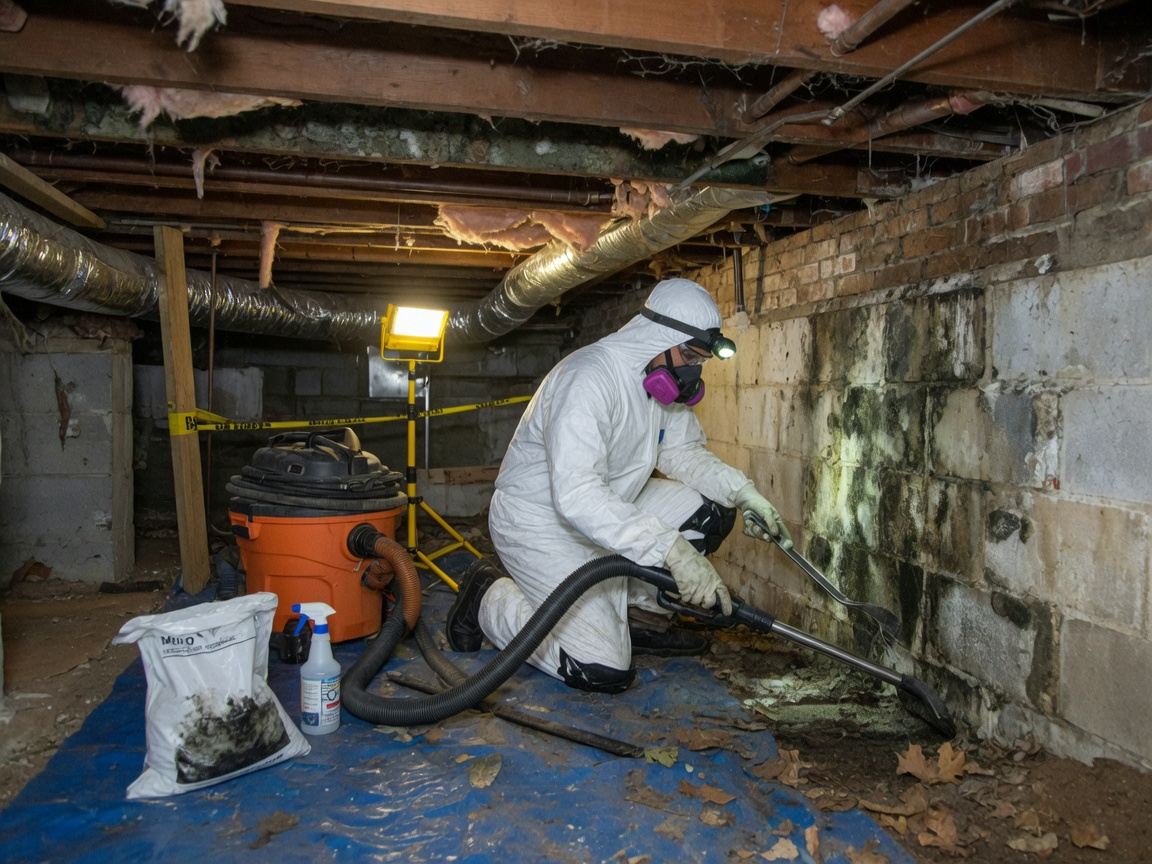
Greensboro crawl spaces in neighborhoods like Fisher Park and Westerwood often sit under 1920s–1950s homes with dirt floors and minimal ventilation. Hot humid summers drive ground moisture upward while mild winters keep temperatures above freezing, allowing mold colonies to grow on joists and insulation without obvious signs upstairs. We begin every job by mapping air flow from the foundation vents to the rim joists, then isolate the space with plastic sheeting before any removal starts.
Once containment is in place we remove affected insulation and treat wood with EPA-registered antimicrobials that stay effective in high-humidity conditions common to Guilford County. In Lindley Park and Sunset Hills properties built on slight slopes we frequently find water entering at the lowest corner of the crawl space; these jobs require re-grading or French drains before sealing. We never rely on bleach because it leaves behind food sources for new growth once humidity returns.
After cleaning we install 6-mil or thicker vapor barriers sealed to the foundation walls and piers, then add dehumidification recommendations sized for the square footage. Homeowners in Downtown Greensboro townhomes sometimes request only spot treatment, but we explain that untreated sections will re-contaminate the cleaned area within one season. Final clearance testing confirms spore counts match outdoor levels before we remove containment.
Technician insight
In Greensboro the thing that catches most people out with Crawl Space Mold Removal is the way older Fisher Park and Westerwood homes trap humidity under closed-off porches; once the porch blocks cross-ventilation the mold returns within a year unless we open or mechanically vent that dead air space.
Westerwood 1940s Bungalow
Homeowner noticed musty smell after heavy summer rain. Inspection found black growth on joists near the back corner where the lot slopes toward the foundation. We contained the space, removed wet insulation, treated the wood, installed a sealed vapor barrier, and added a small dehumidifier. Follow-up testing six weeks later showed outdoor-level spore counts.
Crawl Space Mold Removal Services We Offer
✓Crawl Space Inspection and Assessment
Full visual and moisture-meter inspection of joists, insulation, and soil conditions in Greensboro crawl spaces to identify hidden mold before it spreads upward.
✓Vapor Barrier Installation
Sealed 6-mil or thicker liner attached to foundation walls and piers that blocks ground moisture common in humid subtropical Guilford County homes.
✓Insulation Removal and Replacement
Safe removal of contaminated fiberglass or cellulose followed by new insulation rated for crawl space conditions in older Westerwood and Fisher Park houses.
✓Moisture Source Correction
Grading adjustments, French drain installation, or vent repairs that stop water entry from the slight slopes found in Lindley Park and Sunset Hills properties.
✓Dehumidifier Sizing and Placement
Right-sized units placed to maintain 50 percent or lower humidity year-round in Greensboro crawl spaces where summer dew points stay high.
Crawl Space Mold Removal Cost in Greensboro, NC
| Service | Typical Range | What Affects It |
|---|---|---|
| Basic Crawl Space Mold Removal | $1,200–$2,400 | Smaller spaces under 800 sq ft with accessible entry and no water intrusion |
| Vapor Barrier Addition | $600–$1,100 | Sealed liner only, added during remediation |
| Moisture Correction Work | $800–$2,000 | Grading or drain work on sloped lots in Lindley Park or Sunset Hills |
| Full Insulation Replacement | $500–$900 | Removal plus new R-19 or better insulation |
Ranges are typical for Greensboro, NC and confirmed with an exact written quote before any work starts.
How it works
- 1
Initial Assessment
We map moisture levels, air flow, and visible growth across the entire crawl space while noting foundation type and nearby drainage.
- 2
Containment Setup
Plastic barriers and negative air machines isolate the work area so spores do not migrate into living spaces above.
- 3
Removal And Treatment
Contaminated materials are removed, wood is treated, and any standing water is extracted before drying begins.
- 4
Prevention Installation
New vapor barrier, insulation if needed, and dehumidification recommendations are completed and tested.
- 5
Final Clearance
Air sampling confirms spore counts match outdoor levels before barriers come down and the space is returned to use.
Pricing
Cost depends on square footage, access difficulty, and whether moisture correction is required.