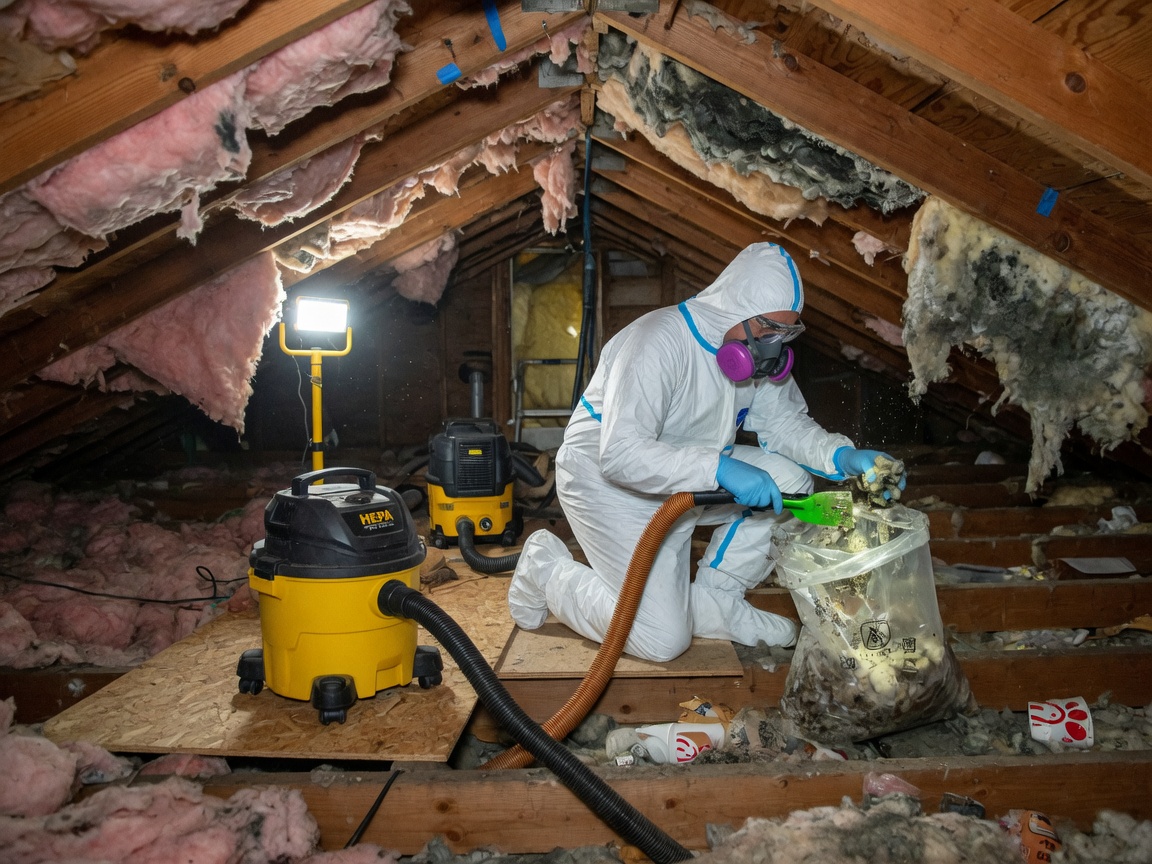
Greensboro's humid subtropical climate brings heavy summer moisture that drives condensation in attics, especially in Fisher Park and Sunset Hills homes built before 1970 with limited ridge venting. Older plaster-and-lath construction and knob-and-tube wiring create hidden pockets where mold colonies spread along rafters without visible ceiling stains. We map airflow with moisture meters and borescopes before any removal to avoid disturbing settled spores into living spaces below.
Guilford County building practices from the 1950s and 60s often left minimal soffit intake, so attics in Lindley Park and Downtown Greensboro retain humidity even after mild winters. Removing insulation without addressing the roof deck temperature differential leads to rapid regrowth within one season. Our process includes negative-air containment tied to exterior exhaust points and post-cleaning verification with ATP swabs to confirm spore counts have dropped below outdoor baselines.
Winston-Salem's similar climate patterns mean many cross-county homeowners see the same issues, but Greensboro's red-clay soil and higher tree canopy around Westerwood increase shade-driven moisture retention on north-facing roof planes. We replace only saturated cellulose or fiberglass while preserving intact material, then install ridge vents sized to the attic square footage to match local code requirements for airflow.
Technician insight
In Greensboro the thing that catches most people out with Attic Mold Removal is how quickly summer humidity re-condenses on unvented rafters in 1950s Fisher Park homes once you pull the old insulation without adding ridge intake.
Fisher Park Attic After Bathroom Exhaust Failure
A 1962 two-story home showed black growth along the north rafters. We traced the moisture to a disconnected bath fan venting into the attic instead of outside. After containing the space and removing wet cellulose, we rerouted the exhaust and added ridge vents sized for the roof plane. Clearance samples came back within outdoor norms and the homeowners reported no musty smell returning during the next humid season.
Attic Mold Removal Services We Offer
✓Attic Insulation Removal
Extract saturated cellulose or fiberglass from rafters in older Greensboro homes while containing spores from drifting into finished spaces below.
✓Rafter Mold Remediation
Apply EPA-registered antimicrobials to exposed roof decking and rafters after source correction in humid subtropical attics.
✓Attic Ventilation Assessment
Measure existing soffit and ridge airflow in Fisher Park and Westerwood homes to identify why moisture accumulates year-round.
✓Moisture Intrusion Tracing
Locate roof leaks, plumbing vents, or bathroom exhaust issues common in pre-1970 Guilford County construction that feed attic mold.
✓Post-Remediation Clearance Testing
Perform surface and air sampling after cleanup to verify mold levels in attics serving Downtown Greensboro and Lindley Park residences.
Attic Mold Removal Cost in Greensboro, NC
| Service | Typical Range | What Affects It |
|---|---|---|
| Attic Inspection And Moisture Mapping | $175–$350 | Higher in multi-story homes or those with limited access in Downtown Greensboro |
| Insulation Removal And Disposal | $600–$1,400 | Varies by depth and whether cellulose or fiberglass in Fisher Park attics |
| Rafter Cleaning And Treatment | $400–$900 | Depends on square footage and extent of visible growth |
| Ridge Vent Installation | $350–$750 | Includes matching existing roof color on Westerwood homes |
| Clearance Testing Package | $225–$400 | Surface and air samples with written report |
Ranges are typical for Greensboro, NC and confirmed with an exact written quote before any work starts.
How it works
- 1
Initial Containment Setup
Seal attic access points with plastic sheeting and negative air machines exhausting outside before disturbing any material in Greensboro homes.
- 2
Source Identification
Use infrared and pin meters to trace active moisture from roof planes or vents common in older Westerwood and Sunset Hills properties.
- 3
Material Removal
Extract affected insulation and clean rafters with HEPA vacuums and antimicrobial agents while maintaining negative pressure.
- 4
Ventilation Correction
Install or enlarge ridge and soffit vents sized for the attic to reduce future condensation driven by local summer humidity.
- 5
Clearance Verification
Conduct final sampling and provide documentation before reopening the space to living areas.
Pricing
Upfront quotes based on attic square footage, insulation depth, and ventilation work required; ranges reflect typical Greensboro jobs.