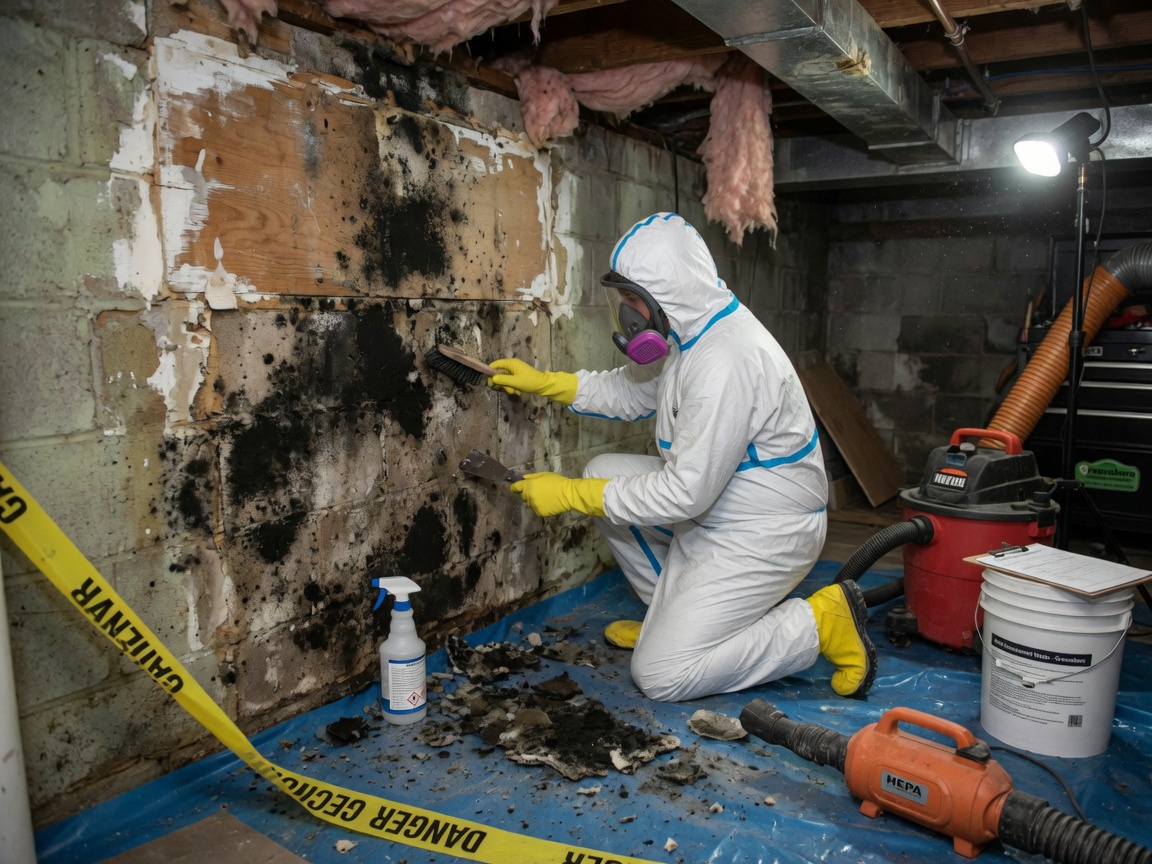
Greensboro’s humid subtropical climate keeps relative humidity high from late spring through early fall, pushing moisture into the unconditioned crawl spaces and attics common in Fisher Park and Westerwood homes built before 1970. When roof leaks or poor gutter drainage allow water to reach cellulose insulation or subfloor framing, Stachybotrys and other black molds colonize quickly. Removal requires full containment, negative air, and HEPA filtration before any drywall or flooring is disturbed; otherwise spores travel through the single-story floor plans typical in Lindley Park.
Guilford County building codes require proper vapor barriers and ventilation in crawl spaces, yet many Sunset Hills and Downtown-adjacent properties still rely on original clay-tile vents that no longer meet current standards. During mild winters, temperature swings between heated living space and cold floors create condensation on ductwork and joists, feeding hidden growth that only appears once occupants notice musty odors near HVAC returns. Technicians must map moisture with meters and borescopes before deciding whether affected joists can be cleaned or must be replaced.
Nearby Winston-Salem shares the same red-clay soils and high water table, so jobs that cross county lines often involve similar foundation drainage issues. After physical removal, rapid drying with commercial dehumidifiers and air movers is essential before any reconstruction; residual moisture left in the clay-heavy soil around older slabs will restart growth within weeks. Homeowners are advised to schedule inspections after any heavy summer rain, especially if the property sits on a slight slope that directs runoff toward the foundation.
Technician insight
In Greensboro the thing that catches most people out with Black Mold Removal is how the red clay around 1950s foundations in Fisher Park and Lindley Park holds water against the sill plate long after rain stops, so simply cleaning visible mold on the floor joists fails if the exterior grading is not corrected at the same time.
Hidden Growth After Summer Storm
Heavy July rain pooled against the rear foundation of a 1962 Sunset Hills home. Musty smell appeared near the HVAC return two weeks later. Inspection found black mold on three joists and insulation in the crawl space where the downspout had clogged. Crew contained the space, removed affected materials, treated the remaining framing, and corrected the exterior drainage before reinstalling a sealed vapor barrier.
Black Mold Removal Services We Offer
✓Crawl Space Black Mold Removal
Full containment and removal of black mold on joists and insulation in Greensboro crawl spaces, followed by antimicrobial treatment and new vapor barrier installation.
✓Attic Mold Remediation
Inspection and removal of mold colonies on rafters and sheathing caused by roof leaks or inadequate ventilation in older Westerwood and Fisher Park homes.
✓Basement Wall Mold Treatment
Targeted cleaning of black mold on concrete and drywall in below-grade spaces common in Lindley Park and Sunset Hills, with moisture source correction.
✓HVAC Duct Mold Cleaning
Removal of mold inside ductwork that spreads spores through single-story Greensboro homes, including register and plenum treatment.
✓Post-Flood Mold Remediation
Rapid response removal after water intrusion from storms or plumbing failures, focusing on saturated subfloors in Guilford County properties.
Black Mold Removal Cost in Greensboro, NC
| Service | Typical Range | What Affects It |
|---|---|---|
| Small contained area under 100 sq ft | $650–$1,100 | Common in single-room attic spots in Sunset Hills homes |
| Crawl space remediation 200–400 sq ft | $1,400–$2,800 | Higher when new vapor barrier and insulation replacement required |
| Full HVAC system cleaning add-on | $450–$750 | Depends on duct length and number of returns |
Ranges are typical for Greensboro, NC and confirmed with an exact written quote before any work starts.
How it works
- 1
Detailed Moisture Mapping
Technicians use meters and infrared cameras to locate all affected materials in crawl spaces, attics, and walls without disturbing settled spores.
- 2
Containment Setup
Plastic barriers and negative-air machines isolate the work zone so mold does not migrate into living areas of the Greensboro home.
- 3
Physical Removal
HEPA-vacuuming, wire-brushing, and disposal of porous materials such as insulation and drywall that cannot be salvaged.
- 4
Drying and Verification
Commercial drying equipment reduces moisture below 15 percent, followed by post-remediation air sampling to confirm clearance.
Pricing
Pricing varies by square footage affected, accessibility of crawl spaces or attics, and whether hidden growth requires opening walls.